
Top 12 Best Donation Platforms for Nonprofits: 2026 | Vee
- Jun 24
- 8 min read
Published: June 24, 2026 · Author May Piamenta
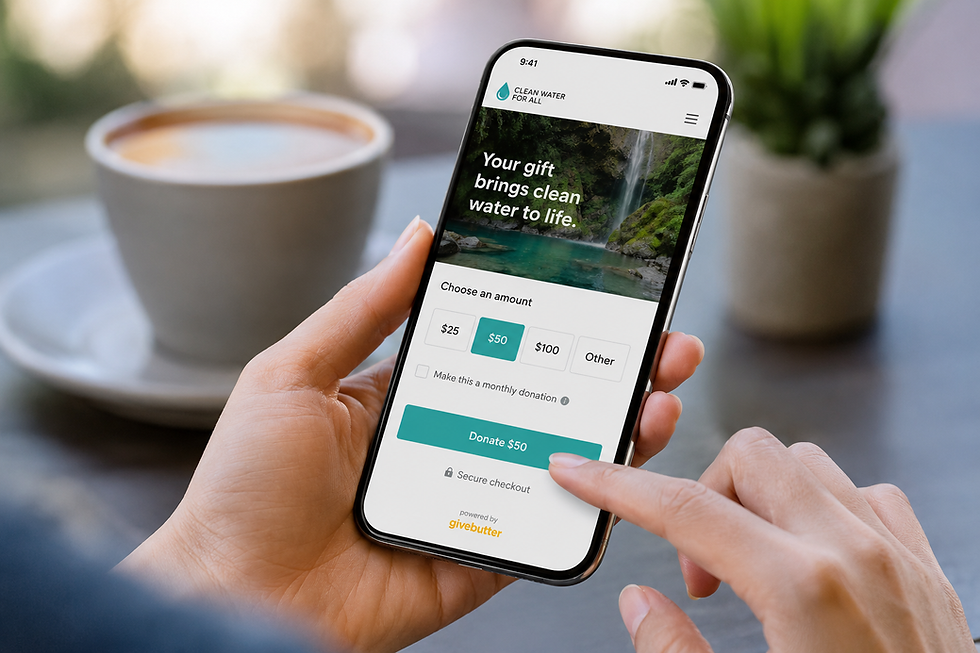
When your team is already stretched across grants, donor emails, events, and reporting, choosing the wrong donation platform doesn't just cost money. It costs hours you don't have. Most comparison guides list features and move on, leaving you to discover later that "free" meant 2.9% + $0.30 per transaction, or that your
shiny new tool doesn't talk to anything else you use. The stakes are real: platform costs range from $0 to over $10,000 annually, and the wrong choice can fragment your data, inflate your overhead, and slow down the donor follow-up that drives retention. This guide cuts through the noise. Here are the 12 platforms worth evaluating in 2026, what they actually cost, and how to match them to where your organization is right now.
Why Your Donation Platform Choice Matters More in 2026

Here's the number that should reframe how you think about this decision: recurring donation revenue grew 36.25% for the average nonprofit between 2023 and 2025, even as one-time gift revenue declined (Neon One 2026 Recurring Donor Report). Small nonprofits specifically saw recurring revenue rise 35.8% over the same period.
Why does that matter for platform selection? Because recurring donors are retained at 78 to 80% year-over-year, compared to just 32 to 36% for one-time donors. Their average donor lifetime is seven to eight years versus under two years for one-time givers. If your platform makes it clunky to set up recurring giving, you're leaving your highest-retention revenue stream on the table.
The macro signals reinforce this. GivingTuesday 2025 generated $4 billion in online donations, proving that intentional digital engagement pays off. Meanwhile, 48% of donors prefer email as their primary channel for updates and appeals (Neon One), and 82% will cover transaction fees when they feel connected to the mission (Mightycause). Donors are ready to give generously. The question is whether your platform is built to capture it.
One tension worth naming: 57% of nonprofit website traffic is mobile, yet desktop still generates the majority of revenue. That "mobile conversion gap" is a platform problem. If your donation form isn't optimized for a thumb-driven checkout, you're losing gifts from donors who were already on your site.
The platform decision isn't a tech choice. It's a revenue and retention strategy. And in 2026, the first question to answer isn't "which platform has the best features" but rather "all-in-one or point solution?"
The All-in-One vs. Point Solution Problem (And the Fee
Math Behind It)
Picture this: a development coordinator at a 4-person nonprofit is juggling a grant deadline, a donor thank-you sequence in Mailchimp, and a donation form on a separate platform that doesn't sync with either. After every campaign, she manually exports donor data, reformats it, and imports it into a spreadsheet. That's not a workflow problem. That's a system architecture problem.
Choosing a "point solution" without a native CRM often results in isolated data and high integration costs. This is the Total Cost of Ownership (TCO) problem, and it hits lean teams hardest. The platforms that serve most organizations well connect giving directly to CRM and automation workflows. Clean data reduces manual work and reporting headaches. As fundraising grows, a connected system consistently outperforms a patchwork of standalone tools.
What "Free" Actually Costs
Fee models in 2026 fall into four buckets. First, zero-fee via donor tipping (Zeffy's model, where 100,000+ nonprofits have raised $2B+ with $0 in platform fees). Second, capped transaction fees (Mightycause at 1.99% + $0.30). Third, uncapped percentage fees (Fundraise Up at 4%). Fourth, subscription plus lower transaction fees.
The tipping model deserves honest scrutiny. It eliminates overhead for your organization, but it asks donors to cover costs at checkout. The real question is whether that friction reduces primary donation amounts or increases cart abandonment. For some organizations and donor bases, it works beautifully. For others, it introduces a philosophical awkwardness that undermines the giving experience.
The uncapped 4% fee at Fundraise Up is a different kind of risk. At $500,000 in annual donations, that's $20,000 in fees alone, before you factor in the cost of a separate CRM. That's budget volatility most small teams can't absorb.
The Integration Tax
Disconnected tools create what practitioners call the "integration tax": time spent manually syncing data between your donation platform, email tool, and donor database. Every hour spent on that is an hour not spent on mission work.

CRM-integrated platforms are essential infrastructure in 2026. They automate engagement without siphoning mission-critical funds through hidden subscription costs. There's also a security dimension worth flagging: as nonprofits collect more donor behavioral data, they become prime targets for cyber threats. Data
security is now a board-level fiduciary responsibility, not just an IT concern.
With the cost and integration framework in place, here's how the 12 leading platforms actually stack up.
The Top 12 Donation Platforms for Nonprofits: Head-to-Head
1. Vee Best for teams that need more than a donation form. Vee is AI built specifically for nonprofits, helping organizations write grants, manage fundraising, and automate donor communications from one place. Where donation platforms stop at the transaction, Vee addresses what happens before and after: the grant that funds the campaign, the email sequence that converts a first-time donor into a recurring one, and the reporting that proves impact. For organizations drowning in disconnected workflows, Vee is the operational layer that ties everything together.
2. Zeffy Best for: budget-first nonprofits with simple needs. Zeffy charges nonprofits zero fees using a donor tipping model. The full feature set includes donation forms, event ticketing, peer-to-peer, auctions, raffles, memberships, e-commerce, and built-in donor management. Over 100,000 nonprofits have raised $2B+ on the platform. Limitation: the tipping model may introduce checkout friction, and the philosophical question of asking donors to cover costs is worth thinking through for your specific audience.
3. Givebutter Best for: multi-channel campaigns without platform fees. Givebutter supports campaigns, events, donations, email, and text outreach in one place with no platform fee. Limitation: payment processor transaction fees still apply, so "no platform fee" doesn't mean zero cost.
4. Bloomerang Fundraising Best for: all-in-one with CRM plus AI-powered insights. Bloomerang combines donor management, volunteer management, and fundraising in one system with no manual data syncing required. Limitation: higher price point than pure donation tools, which may be a barrier for very early-stage organizations.
5. Donorbox Best for: teams with an existing CRM that need strong integrations. Donorbox has a robust API and plays well with most CRM and email stacks. Limitation: it delivers best value only if you already have a CRM. Without one, you're back to the integration tax problem.
6. Fundraise Up Best for: AI-optimized checkout when you have the budget for it. Fundraise Up uses machine learning to right-size ask amounts and prompt recurring upgrades at checkout. It supports 195 countries and modern payment methods. Limitation: no built-in CRM, a 4% uncapped fee that creates real budget volatility, and a high TCO that can surprise teams post-onboarding.
7. Mightycause Best for: budget-conscious all-in-one with a free CRM. Nineteen years of experience, $0/month subscription, fees capped at 1.99% + $0.30, and a built-in CRM included. Limitation: less design flexibility than campaign-first platforms, which matters if visual storytelling is central to your fundraising strategy.
8. Virtuous Raise Best for: relationship-focused fundraising with real-time automation. Every gift updates a complete donor profile instantly, connecting directly to automation workflows. Limitation: it's part of the broader Virtuous ecosystem, which may be more infrastructure than a very small organization needs.
9. Funraise Best for: advanced features including crypto donations and Google Pay. Funraise offers crowdfunding, peer-to-peer, donor portals, and a wide payment method library. Limitation: the feature depth comes with a steeper learning curve that can overwhelm lean teams.
10. Raisely Best for: design-forward, branded campaign storytelling. Raisely excels at visual, narrative-driven fundraising pages. Limitation: lighter on CRM and automation features, so it works best as part of a larger stack.
11. Neon One Best for: CRM integration with online fundraising tools. Neon One is frequently cited for connecting donor data to online giving. Limitation: platform complexity may require meaningful onboarding time.
12. Kindful (Bloomerang) Best for: donor management plus fundraising in one place. Kindful has been integrated into the Bloomerang ecosystem, giving it the same CRM strengths. Limitation: teams evaluating Kindful should understand they're now buying into the Bloomerang platform architecture.
A feature list is only useful if you know which criteria to prioritize. Here's a practical framework for making the final call.
How to Choose the Right Platform for Your Team
The single most useful question to ask before evaluating any platform: does this reduce manual work or create more of it?
From there, run every option through five filters. First, TCO, not just sticker price. Second, CRM connectivity. Does it connect to how you communicate with donors? Email is the top channel at 48% preference. Third, mobile checkout optimization. Closing the mobile conversion gap matters. Fourth, recurring giving tools. This is your highest-retention revenue stream. Fifth, fee structure transparency. Does the cost stay predictable as you grow, or does an uncapped percentage fee create budget volatility at scale?

The all-in-one wins for teams wearing too many hats. Point solutions only win if a strong CRM already exists and your team has bandwidth to manage integrations. If you're switching platforms, ask one more question before you commit: what happens to your donor data if you leave?
Quick-Match Guide by Organization Profile
Budget-first, simple needs: Zeffy or Mightycause
Multi-channel campaigns without platform fees: Givebutter
Already have a CRM, need integrations: Donorbox
AI-optimized checkout with budget for high TCO: Fundraise Up
All-in-one with CRM and automation: Bloomerang or Virtuous
Design-forward campaign storytelling: Raisely
Advanced features with modern payment types: Funraise
Choosing a platform solves the "where do donations go" problem. But it doesn't solve the larger operational challenge: what happens before and after the donation. That's where most lean teams lose the most time.
FAQ
What is the best free donation platform for nonprofits in 2026?
Zeffy is the only platform that charges nonprofits zero fees: no platform fee, no transaction fee, no credit card processing fee. It uses a donor tipping model to cover costs. Mightycause is also $0/month with fees capped at 1.99% + $0.30, making it a strong alternative for teams that prefer not to rely on donor tips. Both are worth evaluating depending on your donor base and how you feel about the tipping model trade-off.
How much do nonprofit donation platforms typically cost?
Costs range from $0 to over $10,000 annually. Transaction fees vary from a capped 1.99% (Mightycause) to an uncapped 4% (Fundraise Up). The real cost includes hidden integration expenses when a platform lacks a built-in CRM. Teams often end up paying for separate donor database tools, which inflates the true Total Cost of Ownership well beyond the platform's advertised price.
Do donation platforms include donor management tools?
Some do, some don't. Zeffy, Mightycause, and Bloomerang include built-in donor management. Donorbox and Fundraise Up are designed to integrate with external CRMs, which means additional cost and complexity. If your team is small and already stretched, choosing a platform with native donor management eliminates one more tool to manage and one more data sync to maintain.
The Operational Gap No Donation Platform Fills
Here's the honest reality after evaluating all 12 platforms: even the best donation platform is only one piece of the puzzle. It handles the transaction. It doesn't write the grant that funds the campaign. It doesn't draft the donor stewardship email that converts a one-time giver into a recurring supporter at 78% retention. It doesn't help you report impact to your board or manage the competing priorities that fragment a small team's attention.
That's the gap Vee was built to fill. Vee gives nonprofits AI tools that handle grant writing, fundraising management, and donor communications in one place, so the same person managing your donation platform isn't also starting from scratch on every grant narrative or manually drafting every follow-up email. Teams using Vee spend less time switching between disconnected systems and more time on the work that actually drives mission impact.
If you've just picked your donation platform and you're realizing the operational chaos doesn't automatically disappear with it, that's the right moment to look at what Vee can do for the rest of your workflow.


Comments