
Why an AI Grant Agent Is a Must-Have for Nonprofits in 2026
- 6 days ago
- 7 min read
Updated: 4 days ago
Published: Aug 10, 2026 · Author May Piamenta

Quick Answer: Grant competition is intensifying: more organizations are chasing a shrinking pool of funders, and manual processes or generic AI tools cannot keep pace. A dedicated AI grant agent retains your organization's context, automates research and drafting, and lets a one- or two-person team submit more competitive applications consistently, without replacing the judgment that actually wins funding.
Table of Contents
Why Grant Writing Got Harder, Not Easier, in 2026 {#harder-not-easier}

Here's the uncomfortable math nonprofit teams are living with right now: more than 1.9 million nonprofit organizations are competing for support from roughly 100,000 private and corporate funders. That ratio was already lopsided before federal funding volatility pushed even more organizations toward private and foundation grants.
According to Professional Grant Writers' analysis of the 2026 funding landscape, roughly two-thirds of nonprofits are now submitting more grant applications than before just to bridge funding gaps, and organizations that lost federal funding are increasing their application load even further to compensate. The same analysis cites Center for Effective Philanthropy survey data showing 87% of foundation leaders report increased demand for funding. On some competitive federal programs, individual award slots draw anywhere from 3 to 20 applications each, depending on the program.
Put simply: the volume of competitive, well-researched applications a nonprofit needs to submit just to maintain its current funding level has gone up, while staffing has not. That gap is exactly where the case for a dedicated AI grant agent starts.
Three Ways Nonprofits Handle Grant Writing (And Why Two of Them Are Losing Ground) {#three-ways}
Most nonprofits handle grant writing one of three ways, and the differences between them matter more in a competitive environment than they did a few years ago.
Approach | What It Actually Looks Like | Where It Breaks Down |
Fully manual | Staff research funders, draft narratives, and track deadlines by hand, often in spreadsheets | Doesn't scale past a handful of applications per quarter; institutional knowledge lives in one person's head |
Generic AI (ChatGPT, Copilot) | Staff paste prompts into a general tool for drafting help | No memory between sessions; re-explaining mission, programs, and funder history every time limits the time actually saved |
Dedicated AI grant agent | A tool built specifically to hold funder history, program data, and organizational voice across the full grant lifecycle | Requires initial setup and trust-building, but compounds in value the more it's used |
The middle option is worth pausing on, because it's the one most teams reach for first, and the one most likely to disappoint. The Charity CFO's analysis of 2026 grant strategy puts it directly: some organizations have won grants that ultimately cost more in administrative time than the funding was worth. Their conclusion is that the nonprofits set up to thrive in 2026 aren't the ones writing the most grants. They're the ones with systems, not scrambles.
A generic AI tool speeds up individual tasks. It doesn't build a system. That distinction is the difference between "essential" and "nice to have."
What "Essential" Actually Means Here {#what-essential-means}
"Essential" is a strong word, and it'
s worth being precise about what it does and doesn't mean.
It doesn't mean every nonprofit needs a subscription tool to survive. Small, low-volume grant programs with one or two applications a year may genuinely be fine without one.

It does mean that once an organization is managing more than a handful of active or pursued grants, at today's level of competition, the cost of not having a dedicated system shows up in concrete ways: fewer applications submitted per cycle, more time spent re-researching funders you've already engaged with, and inconsistent quality when the same person is rushing between three deadlines at once. In a landscape where the same organization is now competing against more applicants for a similar or shrinking pool of awards, the volume and consistency a dedicated agent enables isn't a luxury upgrade. It's closer to table stakes for staying competitive with organizations that have already adopted one.
The comparison worth making isn't "AI grant agent versus doing nothing." It's "AI grant agent versus the version of your organization that's already using one to submit more, better-researched applications than you are this quarter."
Answering the Real Objections {#objections}
"Won't this just produce generic, obviously AI-written proposals?" That's a legitimate risk with general-purpose tools that have no context on your organization. It's a much smaller risk for a tool tr
ained specifically on your mission, programs, and past proposals, since the output starts from your actual voice and data rather than a blank slate.
"Isn't this replacing our judgment with a machine's?" No responsible version of this does that. The strongest use of an AI grant agent handles research, first drafts, and administrative tracking, the parts of the job that were never really about judgment. Funder strategy, relationship management, and final review stay with your team.
"We're a team of one or two people. Is this really worth the setup effort?" This is usually where it matters most. A single-person grant program has no slack for redundant research or rewriting boilerplate for the fifteenth funder. The smaller the team, the more a tool that retains context between sessions compounds in value, because there's no second person to fall back on when institutional knowledge would otherwise be lost.
What a Grant Agent Actually Needs to Do to Earn the Word "Essential" {#what-it-needs-to-do}
Not every tool marketed as an "AI grant agent" actually functions like one. Here's the bar:
Retains context across sessions:
[ ] Remembers your organization's mission, programs, and past proposals without re-briefing
[ ] Connects to your funder history, not just the current application
Covers the full lifecycle, not one step:
[ ] Helps identify better-fit funding opportunities, not just draft text
[ ] Supports drafting and tailoring, not just a first draft you have to substantially rewrite
[ ] Tracks deadlines and application status across simultaneous submissions
Produces output that sounds like you:
[ ] Draws on your actual program data and voice, not generic boilerplate
[ ] Leaves final review and approval with your team, not the tool
Scales with your organization:
[ ] Works for a team of one as well as a team of five
[ ] Doesn't require an AI specialist or IT department to maintain
If a tool can't check most of these boxes, it's a drafting shortcut, not a grant agent, and the distinction matters for whether it actually changes your organization's capacity.
Common Mistakes When Adopting an AI Grant Agent {#mistakes}

1. Choosing a generic AI subscription instead of a nonprofit-specific tool. The setup cost of re-explaining context every session adds up to real lost time over a year.
2. Treating adoption as a one-time setup instead of an ongoing practice. The tools that compound in value are the ones used consistently across every proposal, not activated once and left idle.
3. Skipping human review on final drafts. An AI-assisted draft still needs a person to confirm accuracy, tone, and alignment with funder priorities before submission.
4. Expecting it to fix a strategy problem. A grant agent helps you execute more applications more consistently. It doesn't fix poor funder fit or a program that isn't ready for grant funding in the first place.
5. Underestimating how much manual research time is actually being lost. Teams that haven't tracked their own hours per proposal often underestimate the case for automation until they measure it.
6. Rolling it out to the whole grant portfolio at once. Piloting on your next one or two proposals before expanding gives you a real read on fit before committing fully.
FAQ {#faq}
Is an AI grant agent different from just a grant tracking tool? Yes. A tracking tool manages deadlines and funder records but doesn't write anything. A grant agent covers the writing and research side, funder discovery, drafting, and tailoring, in addition to tracking. The distinction matters because writing and research are where most of the staff hours actually go.
Will funders penalize us for using AI to help write proposals? Most funders care about the quality, accuracy, and fit of the final proposal, not the tools used to produce a first draft. The risk isn't using AI. It's submitting a generic-sounding proposal that doesn't reflect genuine understanding of the funder's priorities, which can happen with or without AI involved.
How is this different from just using ChatGPT for grant writing? ChatGPT has no memory of your organization between sessions. You re-explain your mission, programs, and funder history every time you open a new conversation. A dedicated grant agent retains that context, so each proposal builds on the last instead of starting from zero.
Do we need a large grant portfolio to justify a dedicated tool? Not necessarily. Organizations managing more than a handful of active or pursued grants per year typically see the clearest return, since that's the volume where manual research and drafting start eating disproportionate staff time. Smaller programs may still benefit, particularly if the same one or two people are also handling other responsibilities.
What's the realistic timeline to see a return from adopting one? Most organizations see time savings within the first one or two proposal cycles, since the benefit comes primarily from not re-researching funders and not rebuilding narrative content from scratch each time. The gains typically compound from there as more of your program history and funder relationships accumulate in the tool.
How Vee's Grant Delivers This {#vee}
Everything in this article points to the same conclusion: the nonprofits staying compe
titive in 2026 aren't necessarily writing more grants than everyone else. They're running a system that lets them submit more consistently, without burning out the one or two people responsible for it.
That's what Grant, Vee's AI grant teammate, is built to be. It covers the full lifecycle this article outlines: funder research and matching, drafting and tailoring proposals in your organization's voice, and tracking deadlines across every application in flight, the same systems-first approach that separates organizations pulling ahead from organizations staying stuck.
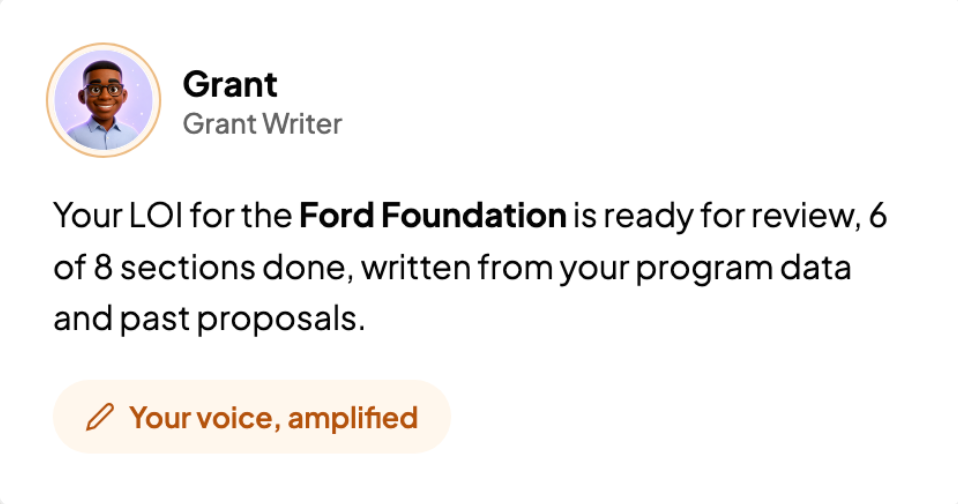
Grant retains your program data, funder history, and voice across every proposal, so your team isn't rebuilding context from scratch each cycle the way a generic AI tool requires. It doesn't replace your team's judgment on strategy or final review. It removes the redundant research and drafting work that was never really about judgment in the first place, which is the same distinction that separates real AI adoption from AI experimentation across every workflow, not just grants. And because grant funding is rarely the only thing competing for a lean team's time, Maggie covers social media in the same platform, so building a grant pipeline doesn't mean letting your public-facing story go quiet. For more on what a strong proposal actually needs section by section, see our grant proposal tips guide.
If your team is already stretched across more funders than you can research and write for manually, book a demo and see what Grant looks like running alongside your work.


Comments