
Grow Your Nonprofit Fundraising Team Without Hiring | Vee
- Jun 23
- 8 min read
Published: June 23, 2026 · Author: May Piamenta
How to Grow Your Nonprofit Fundraising Team Without Growing Your Headcount

Your fundraising team is already stretched.
The same people writing grants are managing donor communications, planning events, and pulling reports, often without a centralized system to keep it all from slipping through the cracks. When revenue goals increase but hiring budgets don't, the pressure compounds fast. The instinct is to think about adding people. But the real leverage is in how your existing team operates. TL;DR: Growing your nonprofit fundraising capacity in 2026 is less about headcount and more about building smarter systems, clearer roles, and the right tools.
In practice, this means owning four core functions — donor acquisition, stewardship, grant management, and reporting — through centralized systems rather than spreading them across more people.
Why "Growing the Team" Means More Than Hiring
Picture this: a three-person nonprofit team where one staff member is simultaneously managing a grant deadline, following up with a lapsed donor, and trying to pull together a board report. None of those things get done well. The grant goes out rushed. The donor doesn't hear back. The report is late. This isn't a staffing problem. It's a systems problem.
Most nonprofits operate with small, multi-hat teams where the same staff handle grants, donor outreach, reporting, and events simultaneously. Competing priorities create a constant state of triage, and without centralized workflows, important work falls through the cracks. According to Candid's March 2026 analysis, sustainable fundraising growth requires building strong donor relationships and consistent systems, not just adding staff. Bloomerang's fundraising strategy framework echoes this: clarity on roles, goals, and processes has to come before you layer on more people or tools.
The risk of hiring without fixing systems first is real. New staff inherit the same chaos. You get more hands in the same mess, and output doesn't meaningfully improve. Hiring is also slow (expect a 3 to 6 month ramp), expensive, and often simply unavailable to budget-constrained organizations. That makes operational efficiency the more accessible lever.
Before you can scale what your team does, you need to understand exactly where capacity is being lost, which leads directly to the question of structure and workflow.
Build the Operational Foundation Before You Scale
Define Roles Around Functions, Not Job Titles
A common pattern in small nonprofits: one person's job description reads like three different jobs. They're the "development coordinator," but in practice they're doing donor acquisition, grant writing, event logistics, and board communications. Nothing gets done consistently because everything is urgent and nothing is owned.

Kindsight recommends building fundraising strategy around clearly defined functions: donor acquisition, stewardship, grant management, and reporting. The team size doesn't matter. What matters is that someone owns each function explicitly. Bloomerang's strategy framework reinforces this, specifically calling out the value of separating donor communication workflows from grant workflows to reduce task-switching and priority conflict.
The practical fix isn't complicated, but it does require honesty. Map your current team's responsibilities to functional buckets. Identify where the same person is covering three or more unrelated areas. Then document what a "handoff" would look like if capacity increased. You're not reorganizing for the sake of an org chart. You're creating the conditions where work can actually be delegated or automated later.
One development director at a mid-sized environmental nonprofit described this restructuring moment plainly: "We didn't hire anyone. We just stopped letting everything land on the same person and started treating grant work and donor stewardship as separate workflows. Deadlines stopped getting missed almost immediately."
Centralize Your Fundraising Workflows
Disconnected processes are one of the top efficiency killers for small fundraising teams. Neon One's research identifies this directly: separate systems for grants, donor data, and communications create duplicatio
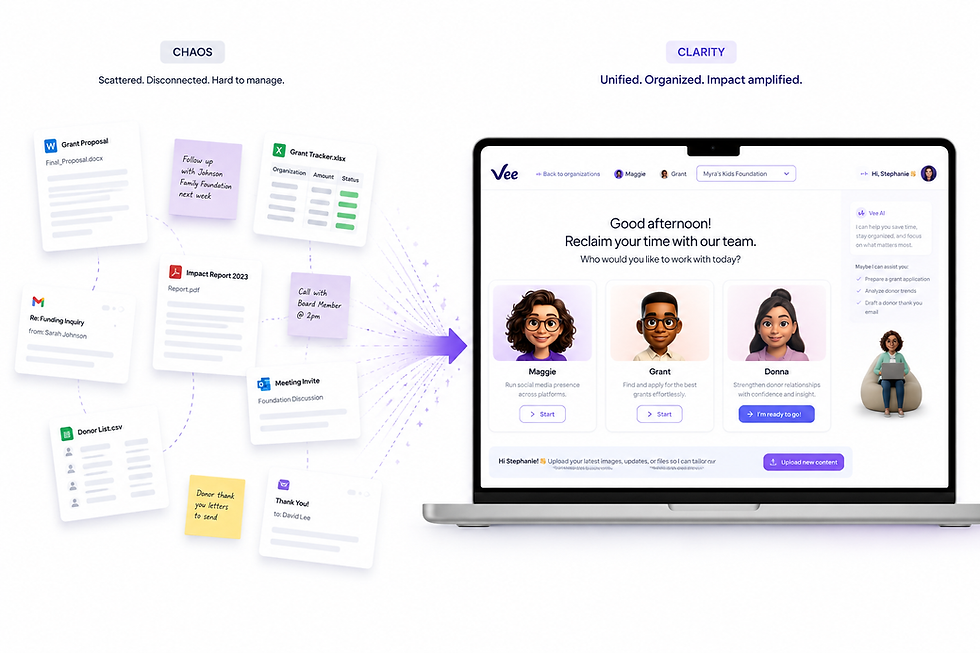
n, data loss, and constant context-switching. Many organizations are running four to six disconnected tools simultaneously, including spreadsheets, email, a CRM, a grant tracker, and maybe a separate event platform.
Nonprofits that centralize donor management and outreach see measurably better retention and campaign performance. The goal isn't to add another tool. It's to create one place where grant status, donor pipeline, and communications history are visible to the whole team. When everyone can see the same picture, priorities align faster and nothing falls through the cracks.
Once your workflows are mapped and centralized, the next multiplier is knowing which fundraising strategies to prioritize, because not all revenue channels are equal for lean teams.
Prioritize the Fundraising Strategies That Scale With Small Teams
Here's a scenario most small nonprofit teams know well: you're trying to run a year-end campaign, a peer-to-peer fundraiser, a grant application, and a major donor stewardship sequence all at the same time. Each one gets partial attention. None of them get done right. The cure isn't more staff. It's fewer channels, executed well.
Recurring giving and major donor cultivation consistently rank as the highest-ROI strategies for lean teams. Recurring donors generate predictable revenue, have lower re-acquisition costs, and require less ongoing effort per dollar raised. Engaging Networks and Blue Avocado both identify monthly giving programs as a high-leverage, sustainable channel for resource-constrained organizations. Major donor cultivation, as Candid notes, means deepening relationships with a smaller number of high-capacity donors rather than running broad acquisition campaigns you don't have the capacity to execute properly.
Grants remain critical but carry a real cost. Grant writing and reporting consistently rank as the number one time drain for small nonprofit teams. They're worth pursuing, but they need to be treated as a managed function, not a constant scramble.
Peer-to-peer fundraising and events are high-effort, lower efficiency for lean teams. They're better delegated to volunteers or deferred until team capacity grows. Digital fundraising, including mobile-optimized giving pages and email automation, offers high leverage with relatively low maintenance overhead.
The key insight is this: small teams that focus on two to three channels consistently outperform those spreading effort thin across six. One small arts nonprofit doubled its annual revenue not by adding channels but by cutting three of them and going deep on recurring giving and a focused major donor program. Less was genuinely more.
Choosing the right strategies is only half the equation. The other half is reducing the manual labor required to execute them, which is where AI-powered tools are changing what small teams can realistically accomplish.
Use Technology to Multiply What Your Team Can Do
Think about how much of your team's week is spent on work that is important but not strategic: drafting a grant narrative, writing a donor thank-you email, segmenting a list before an appeal, chasing down a grant deadline buried in a spreadsheet. These tasks are necessary. They're also exactly the kind of work that AI tools can handle, or at least dramatically accelerate.
AI and automation are reshaping nonprofit fundraising in 2026, particularly for grant writing, donor segmentation, and personalized outreach at scale. The highest-value use cases are practical and immediate: drafting grant proposals, generating
donor thank-you communications, segmenting donor lists for targeted appeals, and tracking grant deadlines. Nonprofits using automation for donor stewardship, including automated receipts, milestone emails, and lapsed donor re-engagement sequences, free up significant staff time without sacrificing relationship quality.
The tools making the biggest difference for small teams include:
Vee , AI built specifically for nonprofits; handles grant writing, donor communications, and fundraising workflows in one centralized platform
Bloomerang , CRM with a donor retention focus
Neon One , Fundraising and donor management platform
Engaging Networks , Online fundraising and advocacy tools
A few important caveats. Generic AI tools, like using ChatGPT without nonprofit-specific context, produce outputs that require heavy editing and miss sector nuance. A grant narrative that doesn't understand the language of program outcomes, funder priorities, or nonprofit reporting standards will cost your team time to fix, not save it. Purpose-built tools reduce that friction significantly.

The other limitation worth naming: automation without strategy can feel impersonal to donors. The goal is to automate the administrative layer while keeping human judgment on relationship decisions. Your team shouldn't be replaced by automation. They should be freed by it.
Teams using AI for grant drafts report saving five to ten hours per week per staff member on writing and revision cycles alone. That's not a small number when your team is already stretched thin.
FAQ
How many people do you need on a nonprofit fundraising team?
There's no universal answer, but research consistently shows that function matters more than headcount. A team of two to three people with clear roles, centralized workflows, and automation tools can outperform a team of six operating in silos. The priority is eliminating redundancy and task-switching before adding staff. Size your team around functions that need to be owned, not around how much work feels overwhelming.
What's the most important fundraising channel for a small nonprofit team?
Recurring giving and major donor cultivation are consistently ranked highest for lean teams because they generate reliable revenue with lower ongoing effort. Grants are essential but time-intensive. Small teams should focus on two to three channels rather than trying to run everything simultaneously. Spreading effort thin across too many channels is one of the most common and costly mistakes small teams make.
How can AI help a nonprofit fundraising team?
AI tools built for nonprofits can draft grant proposals, write donor communications, segment donor lists, and track deadlines, cutting hours of manual work per week. The key is using purpose-built tools like Vee rather than generic AI, which requires significant editing and lacks the sector-specific context that makes outputs actually usable. The right AI tool doesn't replace your team's judgment. It handles the administrative layer so your team can focus on relationships and strategy.
When should a nonprofit consider actually hiring for fundraising?
Hiring makes sense after workflows are documented, roles are defined, and existing tools are being used to capacity. Adding a person before that point usually means they inherit the same operational chaos. The signal to hire is when a specific, well-defined function is consistently bottlenecked despite good systems. If grant writing is still falling behind after you've implemented AI drafting tools and a centralized workflow, that's a real capacity gap. Hire for that gap specifically.
How Vee Helps You Do More With the Team You Have
Everything covered in this article points to the same three barriers: fragmented workflows, time-consuming manual tasks (especially grant writing and donor communications), and the absence of a centralized system where your team can actually see and manage the work.
Vee is built specifically to address all three for nonprofits. It centralizes grant management, automates donor communication workflows, and uses AI trained on nonprofit context to produce grant drafts and outreach copy that actually sounds right the first time. This isn't a generic productivity tool that you have to adapt to your work. Vee is designed around how nonprofit fundraising teams actually operate: grants, donor stewardship, and reporting in one place, not scattered across five disconnected systems.
The specific capabilities matter here. AI grant writing that understands funder language and program outcomes. Donor communication drafting that reflects the voice of your organization. Fundraising workflow management that keeps your whole team aligned on what's in progress, what's due, and what needs attention. Smart automation that reduces the manual layer without removing the human judgment that donors and funders actually respond to.
Teams using Vee aren't waiting to grow their headcount to grow their impact. They're getting more done with the people they already have, on the work that matters most.
If your team is stretched thin and your systems aren't keeping up, explore what Vee can do for your organization and see how it fits your current team structure.


Comments