
The Grant Writing Checklist Every Nonprofit Needs in 2026 (And How to Actually Use It)
Published: July 23, 2026 · Author May Piamenta

Quick Answer: A strong grant writing process runs through five stages: pre-application research, narrative writing, budget development, compliance review, and submission. Most grants are lost before a word is written, through poor funder fit, or afterward, on preventable budget and formatting errors. Treating each stage as a repeatable system - not a one-time scramble - is what separates teams that win consistently.
Table of Contents
You're one or two people managing everything: research, writing, revising, tracking deadlines, submitting - and the rest of your mission doesn't pause while you do it. A missed deadline, a misaligned proposal, or a forgotten attachment can cost months of work and thousands in lost funding. Most generic grant writing checklists hand you a list and walk away, leaving you to figure out how to execute it with a team that's already stretched thin.
This guide gives you a practical, stage-by-stage checklist built for real capacity constraints, plus how to make it work consistently, not just once.
Before You Write a Word: The Pre-Application Checklist {#pre-application}
Here's something experienced grant writers will tell you that most checklists won't: the majority of grant failures are decided before anyone types a single sentence of the proposal. Funders consistently cite poor fit and incomplete organizational readiness as top rejection reasons, not weak writing. You can craft a beautiful narrative and still lose because your program geography doesn't match the funder's priorities, or because you submitted without a current 990 on file.
The pre-application stage is where you decide whether a grant is worth pursuing at all. Skipping it is how small teams end up spending 20 hours on a proposal they were never going to win.
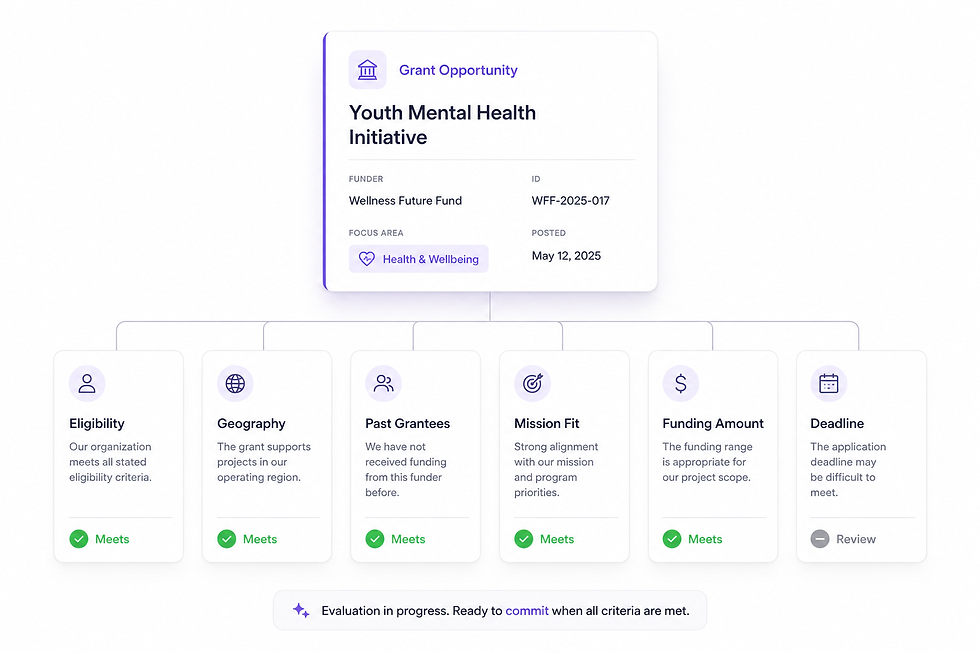
Build a funder profile before you commit. This means documenting alignment between the funder's priorities and your program's outcomes, geography, population served, and funding range. Check their past grantees. If none of them look like you, that's data.
Pre-application documents to have ready:
IRS determination letter (501(c)(3) status confirmation)
Most recent 990
Audited financials or reviewed financial statements
Board of directors list with affiliations
Current organizational budget
Program-specific budget
Proof of insurance
Eligibility check before anything else:
Confirm your organization type qualifies
Verify geographic restrictions
Check funding range against your program budget
Confirm the submission portal is open and you have (or can create) an account
Note the hard deadline and build backward from there
The honest limitation here: manual funder research is slow and inconsistent. Searching databases, reading guidelines, and cross-referencing past grantees can eat two to four hours per opportunity with no guarantee of fit. For a team of one or two, that math gets painful fast - small teams especially can't afford to spend days writing a full proposal for a grant they were unlikely to win in the first place. The pre-application stage is your filter.
Use it ruthlessly.
Once you've confirmed a grant is worth pursuing, the real work begins, and the narrative section is where most lean teams feel the pressure most acutely.
The Proposal Writing Checklist: What Every Strong Application Includes {#narrative}
Think of the proposal as a structured argument, not a form to fill out. Each section exists to answer a specific question the funder is asking. Miss one, and you've left doubt on the table.
A complete grant proposal in 2026 typically includes:
Cover letter (brief, personalized, references the specific program)
Executive summary (one page max, written last, reads first)
Statement of need (with local and community-specific data, not just national statistics)
Program description (what you do, how, and for whom)
Goals and measurable objectives (SMART: Specific, Measurable, Achievable, Relevant, Time-bound)
Evaluation plan (how you'll measure impact, not just activity)
Organizational capacity statement (why your team can deliver this)
Sustainability plan (what happens after the grant ends)
Required attachments (varies by funder, check the guidelines twice)
A few things worth calling out. Your statement of need should use local data - funders want to see that you understand the problem in your specific context, not just that the national statistics are bad. Vague, unmeasurable outcomes are consistently one of the top rejection triggers reviewers cite. "We will serve more youth" is not a goal. "We will serve 120 youth ages 12 to 17 in ZIP code 12345, with 85% completing the 10-week program by June 30" is a goal. For more on structuring a proposal that holds up section by section, see our grant proposal tips guide.

Evaluation plans are increasingly required even for smaller grants. Funders want to know you'll measure impact, not just count heads. And in 2026, proposals that incorporate community voice, equity-centered framing, and evidence-based program models are consistently standing out from the pile.
Tailoring vs. Templating: Where Teams Get It Wrong {#tailoring}
Funders can tell when a proposal is generic. Language that doesn't reflect their priorities, their terminology, or their strategic focus is a quiet red flag that signals you didn't do your homework.
The right approach isn't writing from scratch every time, and it isn't copy-pasting either. Experienced grant writers maintain a content library: pre-written narrative blocks covering organizational history, program descriptions, and outcome data that can be customized per funder. The key word is customized. Pull in the funder's language from their guidelines and strategic plan. Mirror their framing. Show them their priorities reflected back through your work.
The limitation to acknowledge: building and maintaining that content library takes upfront investment. Teams that skip it end up reinventing the same content repeatedly, which is slower and produces less consistent quality. The teams that build it once and update it regularly have a structural advantage.
A compelling narrative is only half the picture. Funders scrutinize budgets just as carefully, and a misaligned or incomplete budget can sink an otherwise strong proposal.
Budget and Compliance Checklist: The Details That Sink Good Proposals {#budget-compliance}
Picture this: a program officer reads your proposal, loves the need statement, believes in your model, and then opens the budget. The staff time is underfunded by half, two line items don't appear anywhere in the narrative, and the math on indirect costs is off. That proposal is now in trouble, and it has nothing to do with your program's merit.
Budget errors are among the most comm
on and most preventable rejection triggers. Here's what a complete budget submission requires:
Budget checklist:
Line-item program budget (costs specific to this grant)
Organizational budget (full picture of income and expenses)
Budget narrative explaining each line item and its calculation
In-kind contributions documented and valued
Indirect cost rate applied correctly (if applicable)
Matching funds documentation if the funder requires a match
Compliance checklist before you hit submit:
Page limits followed exactly
Font size and margin requirements met
All required attachments included (this list varies by funder, read the guidelines)
Online portal registration completed and tested
All required signatures obtained
Submission format confirmed (PDF, online form, or both)
Many funders now use automated pre-screening that disqualifies applications for formatting non-compliance before a human reviewer ever sees them. You can write a perfect proposal and lose on a margin setting.
Build in a 48 to 72 hour buffer before the actual deadline - portal technical issues are common, and funders rarely grant extensions for them. This is also the stage where a second set of eyes, whether from a colleague or a structured review tool, dramatically reduces errors. Tracking compliance requirements across multiple simultaneous applications, each with different rules, is where single-person teams most commonly make costly mistakes.
The 5 Stages at a Glance {#stages-table}
Stage | What Happens | Where Teams Lose Grants |
Pre-Application | Confirm fit, eligibility, and funder alignment | Poor fit, incomplete organizational readiness |
Narrative | Draft the core proposal components | Vague, unmeasurable outcomes |
Tailoring | Customize content to the funder's language and priorities | Generic, obviously templated language |
Budget | Build line-item and organizational budgets | Math errors, budget-narrative mismatches |
Compliance & Submission | Meet formatting rules and submit on time | Automatic disqualification, missed deadlines |
Even with a complete, tailored, compliant proposal, many teams still struggle with the one thing a checklist alone can't fix: doing this consistently, at volume, without burning out.
Common Mistakes That Sink Strong Proposals {#mistakes}
1. Skipping the pre-application fit check. Writing a full proposal for a grant you were unlikely to win wastes days you don't have. Filter ruthlessly before you write a word.
2. Submitting vague, unmeasurable outcomes. "We will serve more youth" tells a funder nothing. Specific, measurable goals with numbers and timeframes are what reviewers are trained to look for.
3. Letting the budget contradict the narrative. Costs that appear in the budget but not the narrative (or vice versa) are one of the fastest ways to signal carelessness to a reviewer.
4. Underfunding staff time or missing indirect costs. Both are common, both are preventable, and both raise doubts about whether the organization actually understands its own program costs.
5. Ignoring formatting and compliance rules. Automated pre-screening now disqualifies non-compliant applications before a human ever reads them. A missed margin setting can cost you the whole submission.
6. Treating tailoring as all-or-nothing. Writing from scratch every time is unsustainable. Copy-pasting the same content into every proposal is transparent to funders. The right approach is a customizable content library, updated and adapted per funder.
FAQ {#faq}
How long should a grant proposal be? Length is determined by the funder's guidelines, and you should follow them exactly. Most foundation grants range from 3 to 10 pages for the narrative. Federal grants can run 20 to 50 or more pages. When guidelines give you a range, err toward shorter and tighter. Reviewers read dozens of proposals and reward clarity over comprehensiveness.
What is the most common reason grant applications get rejected? Poor funder fit is the number one reason: applying to funders whose priorities don't align with your program. After that, the most common causes are vague or unmeasurable outcomes, missing attachments, budget errors, and proposals that don't reflect the funder's own language and priorities. Strong writing cannot compensate for a fundamental mismatch between your work and the funder's goals.
How do small teams manage multiple grant deadlines at once? The teams that manage it well use three tools: a grants calendar with rolling 90-day visibility, a shared tracking system that shows each application's current status, and a content library of reusable narrative blocks. Without those systems, deadline management becomes reactive - you're always responding to urgency rather than working ahead, and that's when costly errors happen.
Should we apply for a grant if we only meet some of the eligibility criteria? Eligibility requirements are non-negotiable. If you don't meet them, do not apply. Fit criteria, such as program focus, geography, and population served, are worth evaluating carefully. If you meet roughly 80% or more of the fit criteria, it may be worth reaching out to the program officer before investing time in a full proposal. A brief conversation can save hours.
Do we need a completely different proposal for every funder, or can we reuse content? Neither extreme works. Writing from scratch every time is unsustainable for a small team, but copy-pasting the same proposal is easy for funders to spot. The middle path is a content library - pre-written blocks on your history, programs, and outcomes - that gets customized with each funder's specific language and priorities before it goes out.
Can AI help with grant writing without producing generic, off-tone proposals? It depends entirely on what the AI is trained on. Generic AI tools produce generic output because they have no context on your mission, programs, or voice. Purpose-built grant writing AI, trained on your organization's actual content and past reporting, can draft in a way that sounds like you rather than like a template - but it's worth testing directly before assuming any AI tool solves this.
How Vee Helps You Run This Checklist at Scale {#vee}
Everything in this article points to the same underlying problem. The checklist itself isn't complicated. The challenge is executing it consistently, across multiple applications, with a small team that's already carrying a full load.
That's exactly what Grant, Vee's AI grant teammate, was built to solve. It's an AI platform built specifically for nonprofits, not a generic writing tool adapted for the sector - which means it understands grant context, mission-driven language, and funder alignment from the ground up, rather than producing the generic, off-tone output you'd get from a general-purpose AI tool.
Here's where Grant directly addresses the friction points this checklist surfaces:
At the pre-application stage, Grant helps you identify better-fit grant opportunities faster, replacing the slow, inconsistent manual database searches that eat hours without guaranteeing results. Better fit at the front of the process means less wasted effort downstream.
In the narrative writing stage, Grant helps you draft and tailor proposals that reflect your organization's voice, programs, and outcomes. It draws on your actual content, not generic boilerplate, so the result sounds like you, not a template.
For consistency and volume, Grant helps teams produce more applications per month without adding headcount or sacrificing quality - more at-bats, at the same quality level, with the same team.
For tracking and submission, Grant supports deadline and submission management so nothing falls through the cracks across simultaneous applications with different rules and requirements.
The key thing Grant is not: a black box that replaces your judgment. It augments your team's expertise rather than substituting for it - you stay in control of strategy, relationships, and decisions. And since fundraising capacity isn't only about grants, Maggie covers the social media side, so your funder-facing story keeps pace while Grant handles the writing and tracking bottlenecks.
Think of Vee as the infrastructure behind the checklist. The stages, the standards, the quality bar - those stay with you. Vee makes it possible to meet that bar consistently, month after month, without burning out the one or two people carrying the program.
If your current grant process feels like a scramble, that's not a capacity problem you can solve by working harder. It's a systems problem. Book a demo and see how Vee fits into your current workflow.


Comments